No means No: “no religious test shall ever be required as a qualification to any office or public trust under the United States”
The “Values Voter’s Conference” has caused quite a stir. A Baptist preacher called Mormonism a cult, and then he said that it disqualified Mitt Romney for the Presidency. The preacher contradicted both the US Constitution and traditional American values.
Our First Amendment rests on the belief that we humans are fallible. We are most fallible when it comes to understanding the mind and intentions of God. Our ways are not God’s ways; our thoughts are not God’s thoughts.
We, the people, have no authority over the religious beliefs of another.  Our Constitution is quite clear: “no religious test shall ever be required as a qualification to any office or public trust under the United States.”
In matters of public affairs, office and trust then, we are required to recognize our mutual folly. We must tolerate our neighbors’ “foolish” ideas and only judge their behavior.  Voltaire expressed this simple idea in “Dogmas” (1765)
“”When all these proceedings were done, I heard promulgated the following decree: ‘ON BEHALF OF THE ETERNAL CREATOR, CONSERVATOR, REWARDER, PUNISHER, PARDONER, etc., be it known to all the inhabitants of the hundred thousand millions of billions of worlds it has pleased us to fashion, that we never judge said inhabitants according to their empty ideas, but solely according to their actions; for such is our justice.'”
You can find the same sentiment expressed in Matthew 25: 31ff
31 “But when the Son of Man comes in His glory, and all the angels with Him, then He will sit on His glorious throne. 32 All the nations will be gathered before Him; and He will separate them from one another, as the shepherd separates the sheep from the goats; 33 and He will put the sheep on His right, and the goats on the left.
34 “Then the King will say to those on His right, ‘Come, you who are blessed of My Father, inherit the kingdom prepared for you from the foundation of the world. 35 For I was hungry, and you gave Me something to eat; I was thirsty, and you gave Me something to drink; I was a stranger, and you invited Me in; 36 naked, and you clothed Me; I was sick, and you visited Me; I was in prison, and you came to Me.’ 37 Then the righteous will answer Him, ‘Lord, when did we see You hungry, and feed You, or thirsty, and give You something to drink? 38 And when did we see You a stranger, and invite You in, or naked, and clothe You? 39 When did we see You sick, or in prison, and come to You?’ 40 The King will answer and say to them, ‘Truly I say to you, to the extent that you did it to one of these brothers of Mine, even the least of them, you did it to Me.’
41 “Then He will also say to those on His left, ‘Depart from Me, accursed ones, into the eternal fire which has been prepared for the devil and his angels; 42 for I was hungry, and you gave Me nothing to eat; I was thirsty, and you gave Me nothing to drink; 43 I was a stranger, and you did not invite Me in; naked, and you did not clothe Me; sick, and in prison, and you did not visit Me.’ 44 Then they themselves also will answer, ‘Lord, when did we see You hungry, or thirsty, or a stranger, or naked, or sick, or in prison, and did not take care of You?’ 45 Then He will answer them, ‘Truly I say to you, to the extent that you did not do it to one of the least of these, you did not do it to Me.’ 46 These will go away into eternal punishment, but the righteous into eternal life.â€
Feed, cloth, visit and heal are all action words. They speak to our actions not to our beliefs. Faith should lead to action. We can see a person’s action; we can’t see faith.
It doesn’t matter whether you approach this issue from the US Constitution, the French Enlightenment or the Gospels, the obvious conclusion is always the same. It is contrary to American ways to attack a candidate on their religious ideas. We must judge them based on what they do, and fail to do, for the American people.
Conservative Zombies are Fake
Halloween is a great time to remind ourselves that all Zombies are fake Zombies. They look real, but we know from observation and reason that they’re not real. There are conservative economists, politicians and historians who dress up their ideas to scare you. Their ideas are Zombies. They may scare people, but when you peel back the mask they are fake just like all the rest.
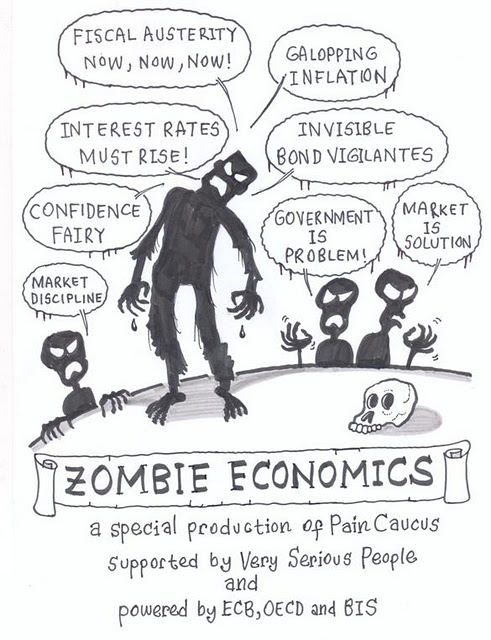
http://acemaxx-analytics-dispinar.blogspot.com/2011/10/zombie-economics-updated.html
the problem we have with conservative politicians and economists
Krugman explains the problem we have with conservative politicians and economists.
It does not matter what the issue is. Over and over again. Make something up and never be accountable. Inflation. WMD. Torture. Banking deregulation. Tax cuts raise revenue. Tax cuts balance the budget. Faith trumps reason.
Closing the Fairness Gap
President Obama talked about “tax fairness” yesterday. To illustrate the “fairness gap” I have modified a chart by the Center for Tax Justice. It charts ALL taxes paid by each income group. Unlike, Conservative commentators the CTJ didn’t single out only income taxes.

You can see that our tax system is designed to be “progressive.” The economically “stronger” among us carry more of the weight. This is real family values. I don’t know of a father who would carry a backpack while the children carried the suitcases.
Because of the voting and donating power of upper middle class Americans, politicians over the last 30 years have lower the taxes for people earning between $150,000 and $1 million. It is this SMALL fairness gap that the President is addressing.
Should someone earning over $340,000 have a lower tax burden than someone earning $150,000? Most Americans would say “no, this is not fair.” Get ready for much screaming to cover up this fact.
Modified Photo from http://www.ctj.org/pdf/taxday2009.pdf
Impeach President Obama? You have got to be kidding me
I wrote the following in response to a friend saying, “Even Glenn Melancon can see the truth,” in this article: “KUHNER: President’s socialist takeover must be stopped.”
This is an extremely silly and poorly thought out article. Once again, I am surprised that an attorney can’t pick this apart at first sight. This garbage is destroying our political system and poisoning our democracy.
A Brief History of Fiscal Responsibility
While crisis economics requires government spending to lessen the damage done to average Americans, sound fiscal policy requires several long-term strategies. Over the last thirty years, Washington policy makers, like American businessmen, have put short-term, temporary gains ahead of long-term, sustainable progress. Solving our problems requires a clear understanding of America’s fiscal history. Liberalism solved our fiscal problems. Conservatism made them worse.
It’s an old adage that an ounce of prevention is worth a pound or cure. Collapsing financial markets don’t have to be expensive. We’ve known about financial bubbles since the 1700s, when the Amsterdam market create a bubble in tulip bulbs. Luckily, the limited nature of the market meant that the collapse impacted relatively few people.  This began to change in the 19th century as financial instruments crept into more and more parts of the overall economy and bank failures occurred almost very 20 years.
Exposing Reagan’s Big Lie
Several years ago, a former neighbor, Joe Abraham had an idea. He wanted history taught backwards. Instead of starting with past events and coming to the present, he suggested starting with current events and working backwards. As a professional historian, this method just didn’t feel right. My training at USL and LSU had always focused on the move from old to new.
I’ve come to realize that “Dr. Joe” had a good point. Most people look at history and ask, “How did we get here?” In 2011 this question is always on my mind. How did we, as Americans, end up with a powerless government? How did the country, which had put millions of people to work during the Great Depression, had defeated Nazi Germany and Imperial Japan, had built the world’s first middle class society, had put a man on the moon, and had cleaned up a polluted environment, descend into bickering and helplessness?
For nearly fifty years the United States had built a world class society from the bottom up. How did Americans forget Franklin Delano Roosevelt’s 1933 call to collective experimentation and action?
Condensing Friedrich Hayek: How Popularization Radicalized Austrian Economics
In a 1984 interview John O’Sullivan asked Friedrich Hayek to explain the contradiction between the reality of English freedom and his argument that economic planning leads down the Road to Serfdom. Sullivan pointed out that since World War Two, the United Kingdom had adopted “increasing control over industry, over planning, over education, over the provision of welfare, and yet the people in this country don’t feel any less free.” Hayek responded, “I did never say, as it is alleged, that once you go down this track, you are bound to go along to the bitter end.”[1] Just ten short years later, however, this popular mis-characterization of Hayek’s thesis persisted. Gerald O’Driscoll, director of policy analysis at Citicorp and a senior fellow of the Cato Institute, told an audience gathered to dedicate an auditorium in honor of the Austrian intellectual, that “Hayek’s thesis in The Road to Serfdom is that one intervention inevitably leads to another.” [emphasis added][2] Clearly, there is a disconnect between the ideas of Hayek himself and the popular understanding.
The roots of the disconnect stretch back to the arrival of the Road to Serfdom in America. Conservatives in the United States, not only found a simplistic explanation for the rise of European totalitarianism, both Nazism and Communism, but also a tool to attack the foundation of New Deal policies. Like their counterparts in the United Kingdom, ordinary Americans felt free, and American conservatives took it upon themselves to raise the alarm about the inevitable threat of government intervention. Reflecting back on the American popularity of his ideas and the shallowness of that popularity, Hayek said, “Both sides talk about my book. Nobody really read it or studied it.[3]